Nobody owns this server
Ownership · July 28, 2026 · 6 min read
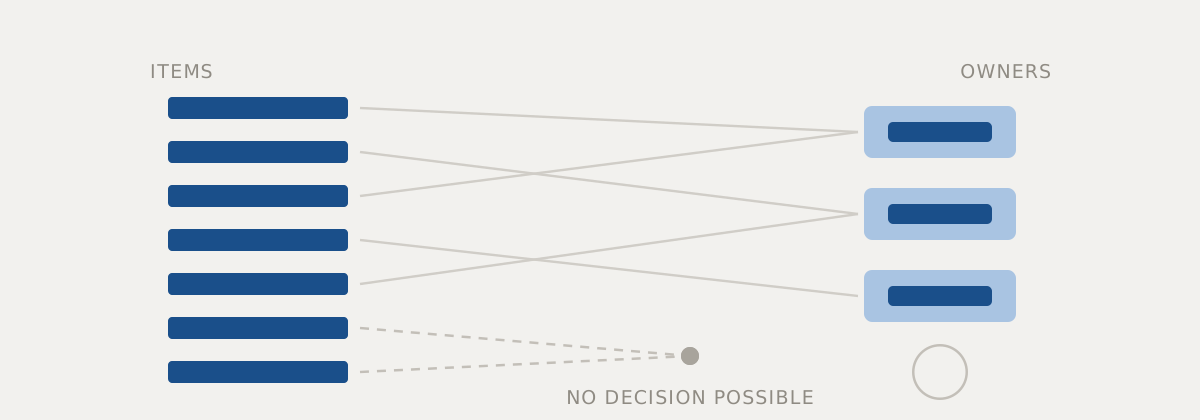
Take a remediation backlog that has been growing for a year and read the items that have been open longest. Very few of them are hard. Almost none of them are open because the patch does not exist, or because applying it is technically difficult, or because somebody lacks the skill. They are open because a decision has not been made, and the decision has not been made because it is not clear whose decision it is.
This is a different problem from the ones remediation programmes are usually designed to solve. Prioritisation schemes assume the constraint is knowing what to do first. Automation assumes the constraint is the labour of doing it. Both are sometimes true. But an item that has sat untouched for eleven months was never waiting on a ranking or on a script. It was waiting on a person, and the programme has no mechanism for producing one.
Three different things called “no owner”
The phrase covers at least three situations that need different responses, and treating them as one is why the generic answer — find the owner and chase them — works so poorly.
The genuinely unclaimed system. It runs. It is known. It appears in every report. It was built for a programme of work that ended, or by a team that was reorganised, or by a supplier whose contract lapsed, and no successor was ever named. Nobody is hiding; there is simply no one whose job includes this machine. Chasing produces polite redirection around a loop until the ticket ages out.
The owner without the authority. Somebody is named, and they genuinely cannot act. The application team owns the risk but the platform team owns the window. The platform team can take the window but the software vendor has not certified the new version, and running uncertified voids the support contract that the business relies on. Everyone in the chain is behaving correctly and the item does not move. Escalating to the named owner is escalating to the one party with no lever.
The owner who is rationally declining. This is the uncomfortable one. The owner understands the request perfectly and is choosing not to. Patching costs them an outage, a regression risk, a weekend, and a chance of being blamed if the change breaks something. The benefit — a reduction in a risk that is probabilistic, diffuse, and belongs to the organisation rather than to them — accrues almost entirely elsewhere. Given that arrangement, declining is the reasonable choice and will remain so however well the request is worded. Persuasion aimed at someone whose incentives point the other way is not a communication problem with a dashboard-shaped solution.
Why escalation does not scale
The default remedy is escalation, and escalation works. It works on a small number of items, a small number of times, because it spends a scarce and non-renewable resource: the willingness of a senior person to expend authority on your behalf. That resource is allocated to whatever is loudest at the moment of asking, which correlates weakly with what is riskiest, and it depletes. A programme that depends on escalation as its ordinary mechanism is a programme that will move a handful of items a quarter and stall on everything else. It is slow in a damaging way, too: it converts a technical question into a political one, which sends it to a queue where it competes with reorganisations and budgets.
Reverse the default
The intervention that changes the shape of the problem is unglamorous and structural. Stop making remediation a request that requires the owner to opt in. Make it a scheduled action that requires them to opt out.
The difference is entirely in who has to act. Under a request model, nothing happens unless the owner does something, so silence produces indefinite delay and the backlog is a list of unanswered messages. Under a default-action model, the notice says the change will be applied in a stated window, and the owner’s options are to accept it, to choose a different window within a bounded period, or to file an exception. Silence now produces the patch.
That single reversal does more than any prioritisation scheme, because it matches the actual distribution of cases. The large majority of items are not contentious; they are unattended. They fail to move not because anyone objects but because nobody has been provoked into acting. A default with an opt-out clears them without a conversation and leaves the programme’s human attention for the minority where somebody genuinely does object.
It also makes silence expensive rather than free, which is the correct signal. If a system matters enough that an unscheduled patch would be damaging, it matters enough for somebody to answer a notice about it.
Two conditions make it safe. The notice period has to be long enough to be actionable and delivered somewhere people actually read. And the change has to be reversible, or the reversal has to be honestly disclaimed — a default action you cannot undo is an unreasonable thing to impose on a system you do not understand.
Exceptions need a name and an expiry
The opt-out route is essential, and it is where the whole model usually rots. An exception without an expiry is not an exception, it is a permanent state achieved through paperwork, and a backlog of those is indistinguishable from having no programme.
Three properties keep an exception meaningful. It names a specific person, not a team and not a role — accountability that belongs to a group belongs to nobody. It has a date on which it lapses and the item returns to the queue automatically, rather than requiring somebody to remember. And it states what is being done in the meantime, because “we cannot patch this” and “we cannot patch this and have therefore done nothing” are very different positions.
The vendor-blocked case is the honest test of this. When a supported version does not yet exist, the item cannot be closed by patching, and pretending otherwise helps nobody. What can be produced is a compensating control, a named accepter, and a date to look again. That is a real answer. “Pending vendor” with no date attached is not an answer; it is a way of storing an item where nobody will look at it.
Measure decisions, not backlog
Backlog size is a popular metric and a poor one. It moves for reasons that have nothing to do with performance — a new scanner, a broader scope, a change in how findings are grouped — and it tells you nothing about whether the machinery is working.
The quantity that actually describes a remediation programme is decisions reached per unit of time: items patched, formally excepted with a name and a date, or determined not to apply. Everything else is inventory in a queue. A programme producing a steady rate of decisions is functioning even if its backlog grows, because discovery is feeding it. A programme with a flat backlog and no decisions is not stable; it is stopped, and the number is hiding it.
Counting decisions also puts the ownership problem in plain view. When the rate falls, the reason is almost never that patching became harder. It is that items arrived somewhere nobody was positioned to say yes or no — a structural condition, and a fixable one.